
20 Habits To Calm Your Mind Every Day
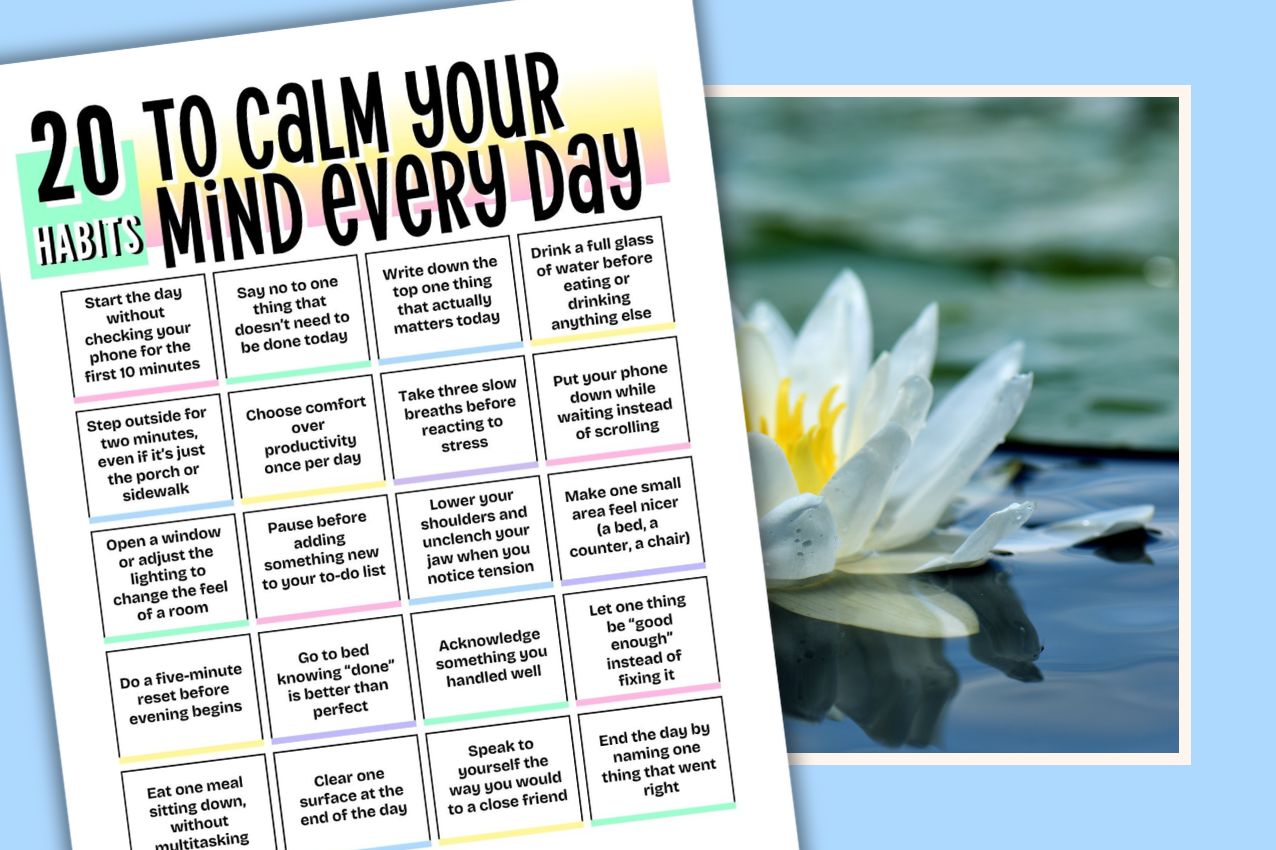
Calm isn’t just about what’s going on around you… it’s also about how you create a way of life for yourself, one tiny calming habit at a time.
Say no to things that don’t work for you… Don’t always reach for your phone… Eat sitting down. Let something be good enough…
The 20 calming habits I’ve put together are the kind of small, repeatable things that genuinely make a difference when you build them into ordinary days.
This post may contain affiliate links.Privacy Policy. Follow us on PINTEREST
None of them require a routine overhaul or an hour of free time. Most take under five minutes. All of them are things you can actually do.
Want to keep these somewhere visible? Grab the free printable below and stick it somewhere you’ll actually see it.
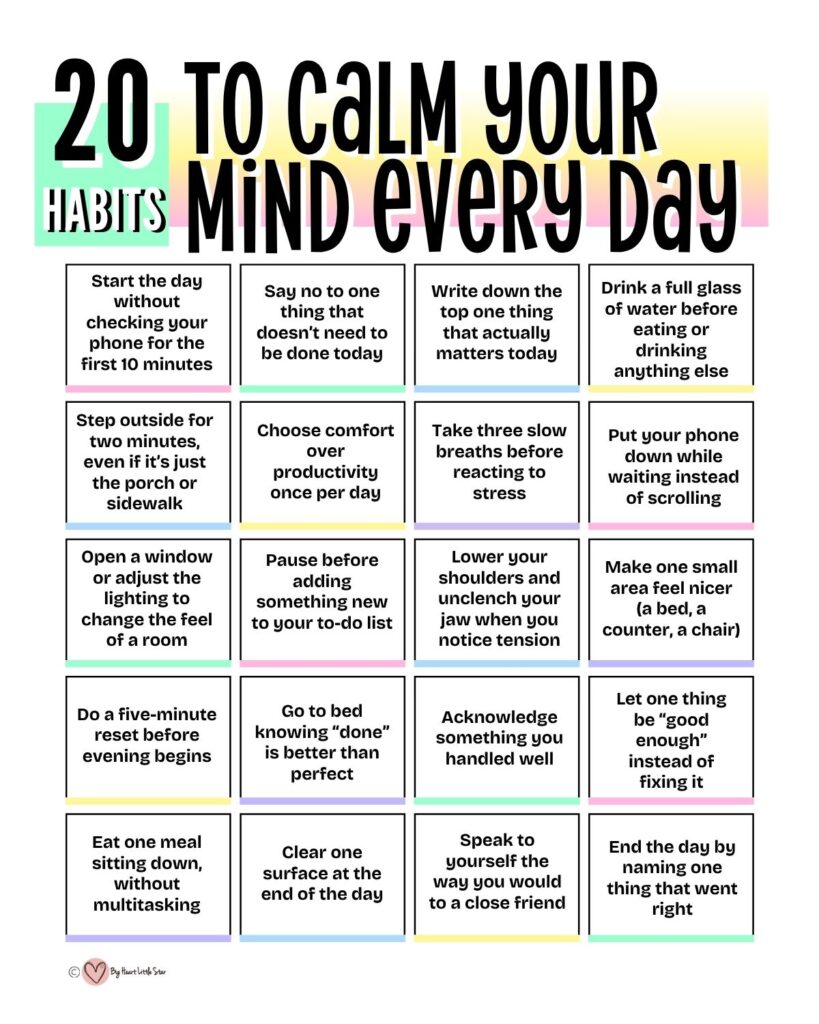
20 Habits To Bring Calm To Your Daily Life
Cherry-pick the ones that resonate with you the most…
Start the day without checking your phone for the first 10 minutes
The phone pulls you into everyone else’s world before you’ve had a moment in your own. Those first ten minutes set the tone for how reactive or how grounded the rest of your morning feels. Try leaving it face-down until you’ve had a drink of water and taken a breath. It sounds small because it is, but it makes a real difference to how you start.
Say no to one thing that doesn’t need to be done today
Not everything on the list is genuinely urgent. Part of calming your mind is getting honest about what’s actually a priority today versus what’s just sitting there generating low-grade anxiety. Choosing one thing to push or drop entirely is a form of decision-making that protects your mental bandwidth for what matters.
Write down the top one thing that actually matters today
When everything feels equally important, nothing is. Writing down the single most meaningful thing you could do today cuts through the noise and gives you an anchor. You might do twelve other things, but knowing which one actually counts changes how you move through the day.
Drink a full glass of water before eating or drinking anything else
This one works partly because of the actual hydration, and partly because it’s a pause. Before the caffeine, before the rush, before anything else, you do one deliberate thing for yourself. It’s a quiet signal to your nervous system that the day doesn’t have to start at full speed.
Step outside for two minutes, even if it’s just the porch or sidewalk
You don’t need a walk. You don’t need to be somewhere green or beautiful. Just outside, for two minutes. The change of air, the shift in light, the sensation of being somewhere other than indoors: it interrupts the mental loop in a way that’s hard to replicate inside. Do it when you feel yourself starting to spiral and notice what happens.
Also read: 30 Morning Rituals For Happier Mornings
Choose comfort over productivity once per day
You’re allowed to do something that feels good without it being “productive.” Watch something you enjoy. Read a chapter. Sit without a purpose. Choosing comfort deliberately is very different from collapsing into it out of exhaustion. One is a choice that replenishes you. This habit is about making that choice on purpose, every day.
Take three slow breaths before reacting to stress
You don’t have to respond immediately. When something lands badly, whether it’s an email, a difficult conversation, or just too many things at once, three slow breaths create a gap between the trigger and the reaction. That gap is where you find a more measured version of yourself. It’s not about suppressing how you feel; it’s about choosing how you respond.
Put your phone down while waiting instead of scrolling
Waiting used to be rest. Now it’s an automatic reach for the phone. The next time you’re in a queue, at a red light, or waiting for something to load, try just waiting. Let your mind have the space. You might be surprised how much mental static clears when you stop filling every spare moment with input.
Open a window or adjust the lighting to change the feel of a room
Your environment affects your mood more than you’d think. A room that feels oppressive or stale feeds anxiety; a room with fresh air and better light can shift your energy noticeably. This isn’t about having a beautiful home. It’s about making one small adjustment to the space you’re in, because it changes how being in that space feels.
Pause before adding something new to your to-do list
Before you add it, ask whether it genuinely belongs there today. Lists grow fastest when we use them as anxiety buckets, capturing everything so it doesn’t get lost. The pause creates a moment to decide whether this is a real task, a real priority, or something that can wait, be delegated, or be let go entirely.
Also read: Things to Let Go Of: Say goodbye to mental clutter
Lower your shoulders and unclench your jaw when you notice tension
Your body holds stress before you’re consciously aware of it. Most of us walk around with raised shoulders and a clenched jaw without noticing. Checking in with those two things, and deliberately releasing them, is a tiny physical reset that works fast. The body calms the mind as reliably as the other way around.
Make one small area feel nicer (a bed, a counter, a chair)
You don’t need to declutter the whole house. Clearing one surface, straightening one corner, fluffing the cushions on one chair: when one small area looks and feels better, it sends a quiet signal that things are manageable.
Also read: 30 Quiet Reset Ideas: Small Ways To Come Back To Yourself
Do a five-minute reset before evening begins
Before the evening properly starts, take five minutes to clear the surface, close the tabs, put things where they belong. Think of it as a hinge between the day and the evening: a conscious close to one and a more deliberate start to the other. It stops the mental clutter of the day from bleeding into the time that’s meant to be yours.
Go to bed knowing “done” is better than perfect
Perfectionism is exhausting, and one of the most reliable ways to drain your mental energy is to hold yourself to a standard that doesn’t shift no matter what you’ve managed that day. Choosing to call it done, to let it be enough, to go to bed with that as the operating principle: it is a habit, and it can be practised, even when it doesn’t come naturally.
Acknowledge something you handled well
At some point in the day, notice something you did that was hard, or kind, or just done when you didn’t feel like it. Not in a performative way. Just a quiet acknowledgment to yourself: that was something, and you did it. It counterbalances the running tally of what didn’t get done or didn’t go well, and over time it genuinely shifts how you see your own days.
Let one thing be “good enough” instead of fixing it
Related to perfectionism but different: this one is about the small things. The email that’s fine but you want to reread it one more time. The plan that’s good but you’re still turning it over. The decision that’s made but keeps resurfacing. Letting it be good enough is a skill. Practising it on small things makes it easier on the bigger ones.
Eat one meal sitting down, without multitasking
Even one meal: no screen, no phone, no working through something in your head. Just the food, and the experience of eating it. It sounds like a small thing because it is a small thing, but most of us eat almost every meal as a side activity, and the accumulated effect of that is a nervous system that never quite settles.
Clear one surface at the end of the day
Not the whole kitchen. Not the whole house. One surface. The act of clearing something small signals closure. It makes the morning marginally easier, yes, but more than that it gives the evening a visual sense of order that helps your mind start to settle before sleep.
Speak to yourself the way you would to a close friend
You would not speak to a friend the way most of us speak to ourselves. The internal voice that catalogues every failure, questions every decision, and adds extra weight to ordinary hard days: it doesn’t have to run unchecked. Noticing it, and choosing a gentler version, is not about toxic positivity. It’s about fairness.
End the day by naming one thing that went right
Not as a gratitude exercise if that doesn’t land for you. Just one thing, however small, that went right today. The coffee was good. You made someone laugh. You caught yourself before saying something you’d regret. It doesn’t need to be significant. It just needs to be real. Ending the day with something that went right is a very gentle way to train your brain to look for it.
Also read: 20 Evening Routine Ideas: The Soft Landing You Need At The End Of A Long Day
Keep these habits somewhere visible
Twenty habits is a lot to hold in your head. The printable version of this list is designed to go somewhere you’ll actually see it: stuck to the fridge, propped on your desk, saved to your phone.
Grab the free printable here so you can refer to it daily: 20 Habits To Calm Your Mind printable

Hello, I’m Luci, founder of Mums Make Lists. The site is full of useful and fun ideas for life and seasonal celebrations. Plus a growing selection of instantly downloadable fun printables and party planners. Read more.