
How to Run a Minute to Win It Party for 10, 20 or 30 People
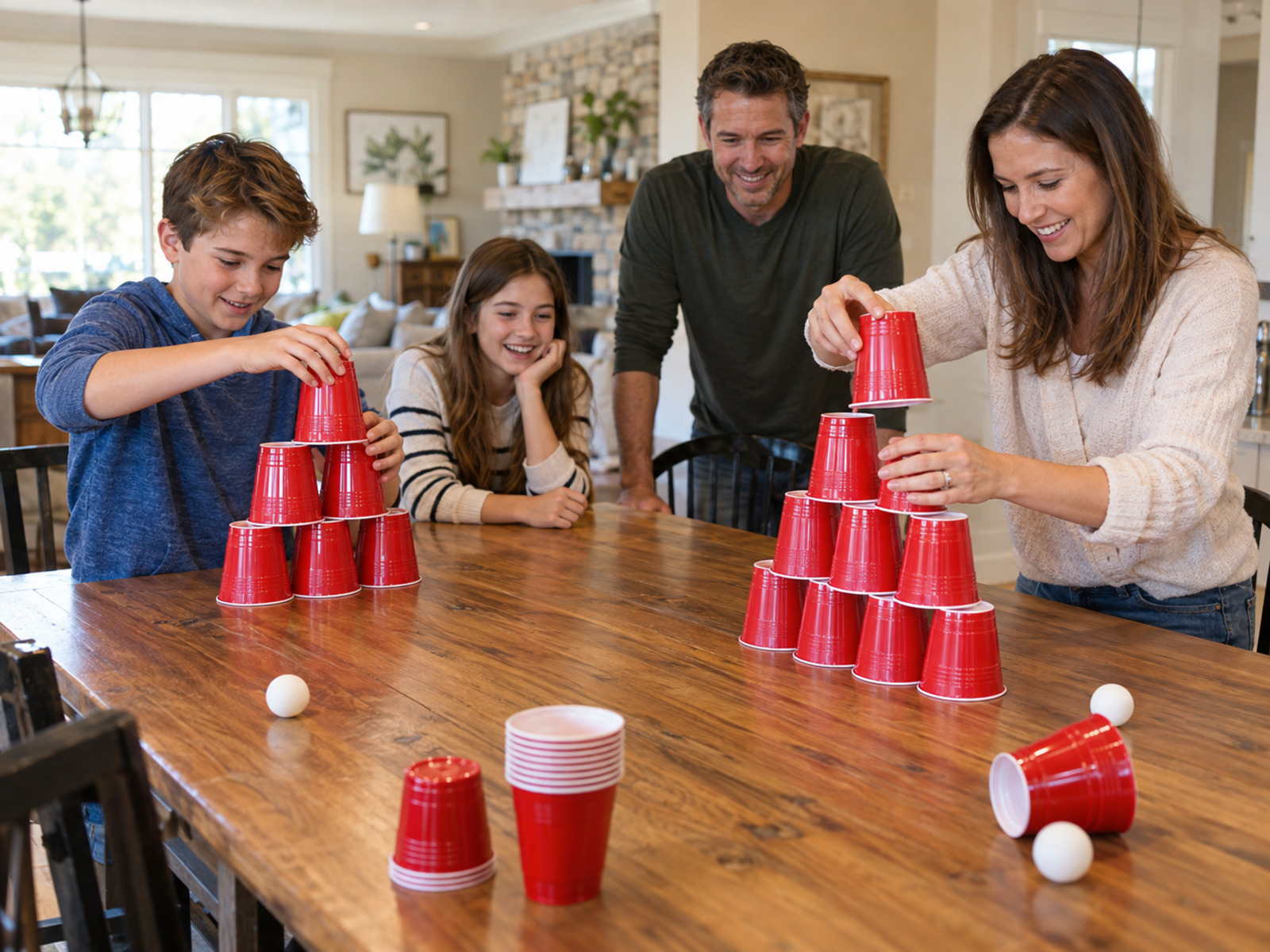
A one-minute game is easy to explain. Running those games for a whole party takes a little more thought: who plays next, who keeps score and what everyone else does while they wait.
This Minute to Win It party plan gives you a six-game lineup, supply quantities and a turn system for 10, 20 or 30 players. It is designed for school-age kids, teens and adults, with mixed-age teams and easier targets where needed. If you want to swap a challenge, choose from my 101 Minute to Win It games for groups.
The simplest way to organize your party
Divide your guests into teams of five. Give each team an identical set of supplies and its own playing area. Everyone plays the same game at the same time, with one player from each team taking a turn in each heat.
This post may contain affiliate links.Privacy Policy. Follow us on PINTEREST
Run five heats per game so every team member gets a turn. Then move on to the next game. Six games give each guest six turns, rather than leaving the same confident player to represent the team all evening.
A heat is one shared 60-second attempt. A game round contains five heats. Keeping those two terms separate makes the schedule much easier to explain.
Your plan for 10, 20 or 30 players
10 players: two teams of five
Set up two playing areas. A long dining table may be enough for the cup, coin and ball games, provided there is room between players. Keep a separate clear area for the balloon and sock challenges. One host can start the timer and check both results.
20 players: four teams of five
Set up four identical playing areas. Two tables with two teams at each can work for tabletop challenges. Appoint a scorekeeper on each team, rotating that role when it is their turn to play. The host gives one countdown so all four players start together.
30 players: six teams of five
Use six playing areas only if your room comfortably accommodates them. Ask one or two helpers to check results and resets. Keeping everyone on the same challenge makes hosting easier than trying to explain six different stations at once.
For an awkward guest count, balance teams as closely as possible and keep five scoring turns per game. On smaller teams, rotate the extra turn between players across the evening. A sixth person can share a turn, take a non-playing role or swap into the next game. Each team still receives the same number of scoring attempts.
Choose games you can reset quickly
The lineup below uses reusable household supplies and skips eating challenges. These are party versions with specific targets, so you can explain the scoring before anyone begins. Try the targets yourself before guests arrive and adjust them to suit your crowd.
1. Cup Pyramid
Per team: 10 matching plastic cups and a flat surface.
The challenge: Build a pyramid with four cups on the bottom, then three, two and one. Return all 10 cups to a single nested stack before the minute ends. The pyramid must stand on its own before unstacking begins.
Reset: Hand the nested stack to the next player. For younger players, use six cups arranged three, two and one.
2. Penny Tower
Per team: 20 same-sized coins.
The challenge: Using one hand, build a freestanding tower of 15 coins within 60 seconds. It must stay standing for a count of three. If it falls, the player can start again while time remains.
Reset: Spread the coins out again. Use a lower target for younger players and keep loose coins away from toddlers.
3. Bounce Into the Cup
Per team: Five ping-pong balls and one wide plastic cup.
The challenge: Bounce a ball once on the table so it lands in the cup. Land three balls before time runs out. Agree the throwing line and cup position beforehand. A teammate may return missed balls but cannot move the cup.
Reset: Empty the cup and collect all five balls. Choose a larger target container if the cup version is too frustrating.
4. Balloon Keep-Up
Per team: One inflated balloon and clear space.
The challenge: Keep the balloon off the floor for the whole minute using hand taps. No catching or holding it. A floor touch ends that attempt; the player stays nearby to cheer on the others.
Reset: Pass the balloon to the next player. A shorter agreed target can suit younger children. Skip this game if balloons are unsuitable for your guests.
5. Sock Toss
Per team: Five rolled pairs of socks and a laundry basket.
The challenge: Toss at least three sock balls into the basket from an agreed line. Each player gets five throws within the minute. No retrieving missed throws during that heat.
Reset: Collect the five sock balls. Set a nearer line for younger children before the game begins.
6. Bottle Flip
Per team: One capped plastic water bottle, partly filled.
The challenge: Flip the bottle and land it upright once within 60 seconds. It must remain standing for a count of three. Keep trying after failed flips.
Reset: Return the bottle to the starting position. Test the fill level and surface beforehand; use the same bottle type and fill level for every team.
How many supplies do you need?
These quantities cover the complete six-game lineup. Reuse one of each team’s 10 cups for Bounce Into the Cup.
- 10 players: 20 cups, 40 coins, 10 ping-pong balls, two playing balloons plus spares, 10 rolled pairs of socks, two baskets and two bottles.
- 20 players: 40 cups, 80 coins, 20 ping-pong balls, four playing balloons plus spares, 20 rolled pairs of socks, four baskets and four bottles.
- 30 players: 60 cups, 120 coins, 30 ping-pong balls, six playing balloons plus spares, 30 rolled pairs of socks, six baskets and six bottles.
You also need one shared timer and a way to record scores. Check what you already have before buying supplies. If you do not have six baskets or enough tabletop space, change the lineup or use the smaller-space format below.
Keep scoring to one point per successful turn
Give a player one point for completing the agreed target and zero if they do not. Add the five player results to get the team’s score for that game: zero to five points. Six games give a maximum team score of 30.
For example, if three players complete Cup Pyramid and two do not, the team earns three points. You do not also award extra points for speed.
Write down each game’s team score before clearing the supplies. Keep the completion targets consistent throughout the round. If different age groups use different targets, explain those adjustments before starting.
If the final totals tie, share the win or run one extra Cup Pyramid heat with one volunteer from each tied team. For a tiebreaker, fastest complete pyramid-and-unstack wins; if nobody finishes, repeat with the easier six-cup version.
Allow around 75 to 90 minutes
The playing time alone is 30 minutes: six games multiplied by five one-minute heats. Resets, demonstrations and collecting stray balls take additional time. Use this as a planning estimate, rather than promising a precise finish.
- Opening, around 10 minutes: form teams, choose names, explain scoring and show how a heat works.
- First three games, around 25 to 30 minutes: demonstrate each challenge, run five heats and record the result.
- Break, around five minutes: drinks and a chance to reset the room.
- Last three games, around 25 to 30 minutes: repeat the same format.
- Finish, around five minutes: total the scores and announce the result.
For a shorter session, play three games with all five heats. Everyone still gets three turns, and you can save the remaining challenges for another gathering. For a break between challenges, choose one of my indoor group games without equipment.
What if you only have one playing table?
Use two teams of five at a time, with two identical supply sets. For 20 guests, one pair of teams plays while the other pair watches, then they swap. For 30 guests, run three pairs in succession.
This reduces your equipment needs but increases waiting time and the length of the session. Cut the lineup to three games, or make the challenges a drop-in activity rather than promising the full schedule above.
Small hosting choices that keep things moving
- Choose the player order first. Keep that order for all six games so nobody has to negotiate the next turn.
- Demonstrate the finish. Show what counts as a completed challenge, including what must remain standing.
- Stop for resets. Start the next minute only when every playing area is ready.
- Give helpers a job. Returning balls and recording points keeps waiting teammates involved.
- Allow a pass. Guests can help with scoring or resetting instead of taking a turn. In a competitive game, agree substitutions before the round.
- Keep supplies comparable. Different cup shapes, basket distances or bottle fill levels can turn a close game into an argument.
What to write on your score sheet
Put the team names across the top, with one row for each game. Record only the team’s total out of five in each game row, then add the six rows at the end. Keep a small space for the completion targets and any age adjustments so you can refer back to them.
A blank score sheet works with any lineup. You can use the plan here, choose different challenges or bring it out again for a holiday party. The useful part is having the scoring settled before the first countdown.

Hello, I’m Luci, founder of Mums Make Lists. The site is full of useful and fun ideas for life and seasonal celebrations. Plus a growing selection of instantly downloadable fun printables and party planners. Read more.