
30 Ways to Set Your Boundaries and Put Yourself First (Free Printable)

Boundary-setting isn’t really about pushing people away. It’s about figuring out where you end and everyone else’s expectations begin… and deciding, quietly and firmly, that the line matters.
Most of us weren’t taught how to do this. We were taught to be accommodating, to explain ourselves, to soften every no until it barely sounded like one. So if you’ve spent years saying yes when you meant no, apologizing for your preferences, or waiting for permission to take up space… this one’s for you.
This free printable gives you 30 ways to start practicing. Not a lecture, not a 12-step program. Just 30 specific, doable prompts that help you build the muscle. Because that’s what boundaries are; a skill, not a personality type. Something you get better at by doing it once, then again, then again.
This post may contain affiliate links.Privacy Policy. Follow us on PINTEREST
You don’t have to work through all 30. Pick the one that makes you slightly uncomfortable and start there. That’s usually the right one.
Download your free printable at the end of the post — all 30 prompts in one place, ready to print and work through at your own pace.
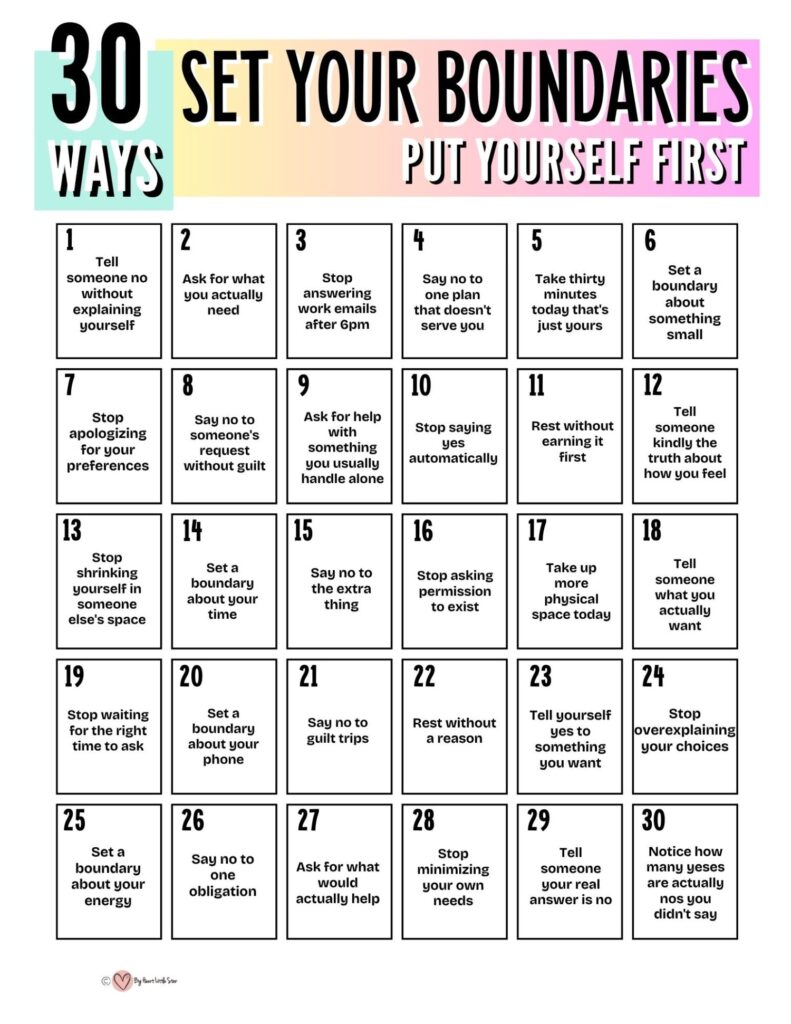
1. Tell someone no without explaining yourself
A no is a complete sentence. You don’t need a reason good enough to justify it, and you don’t need to wait until you have one. Practice saying “I can’t make that work” and leaving the space after it empty. The urge to fill the silence with excuses is just habit — one you can unlearn.
2. Ask for what you actually need
Not what seems reasonable. Not what you think you’re allowed to want. What you actually need. This one feels vulnerable because it requires admitting you have needs at all — which, if you’re used to running on empty and calling it fine, is its own kind of boundary work.
3. Stop answering work emails after 6pm
Your inbox is not an emergency room. When you respond to work messages in the evening, you’re training everyone around you to expect it — and training yourself to never fully switch off. Set the boundary once, hold it consistently, and let the boundary do the work so you don’t have to keep explaining it.
4. Say no to one plan that doesn’t serve you
Look at your calendar and find the thing you said yes to out of guilt, obligation, or the vague hope that you’d feel differently by the time it came around. Cancel it. You’re allowed to protect your time and your energy for things that actually matter to you.
5. Take thirty minutes today that’s just yours
Not productive time. Not helpful time. Time that belongs to you for no reason other than the fact that you need it. Thirty minutes where you’re not available, not useful, not catching up. Just present with yourself. It counts. It matters. It’s enough.
6. Set a boundary about something small
You don’t have to start with the hard ones. Pick something low-stakes — a small habit someone has that bothers you, a minor yes you keep saying when you mean no. Small boundaries build the muscle for the bigger ones. Starting small isn’t avoiding the work, it’s doing it in the right order.
7. Stop apologizing for your preferences
You don’t like crowds. You need more sleep than most people. You’d rather stay home than go out this weekend. None of these are personality flaws that require an apology. They’re just true things about you, and you’re allowed to name them without shrinking around them.
8. Say no to someone’s request without guilt
Guilt after saying no is normal — but it’s not a sign you did the wrong thing. It’s just the feeling that comes when you break a pattern that’s been in place for a long time. Feel the guilt, hold the boundary anyway, and notice that the world didn’t end.
9. Ask for help with something you usually handle alone
Doing everything yourself isn’t strength. For a lot of us, it’s a coping strategy that stopped working a long time ago. Asking for help is a boundary too — one that says your capacity has limits and that’s not a problem to hide.
10. Stop saying yes automatically
Notice the next time a yes comes out of your mouth before your brain has had a chance to weigh in. That automatic yes is worth examining. Try replacing it with “let me check and come back to you” until saying yes becomes a choice rather than a reflex.
11. Rest without earning it first
You don’t need to finish the to-do list before you’re allowed to rest. You don’t need to have had a hard enough day to justify sitting down. Rest isn’t a reward for productivity. It’s a need — and treating it like one is a boundary you set with yourself.
12. Tell someone kindly the truth about how you feel
Not the edited version. Not “I’m fine” when you’re not. The actual truth, delivered with care. This is one of the most intimate boundaries there is — the one that says your inner experience is real and worth communicating, even when it’s inconvenient for the moment.
13. Stop shrinking yourself in someone else’s space
Notice when you make yourself smaller to keep the peace — quieter, less opinionated, less present. You’re allowed to take up the space you actually occupy. Your voice doesn’t need to be turned down to a volume that feels comfortable for everyone else.
14. Set a boundary about your time
Time is the one thing you cannot get back, and yet most of us give it away faster than anything else. Decide what your time is worth to you and start treating it accordingly. That might mean saying no to a meeting, cutting a commitment short, or simply not being available on demand.
15. Say no to the extra thing
The extra task someone assumed you’d take on. The additional favor tacked on at the end of a request. The thing that wasn’t in the original agreement. You don’t have to absorb everything that lands near you. “That’s not something I’m able to take on right now” is a full and complete answer.
16. Stop asking permission to exist
You don’t need approval to have opinions, to take up space, to want things, to feel things, or to be exactly who you are in a room full of people. The habit of waiting for permission is usually old, and it’s usually not yours — but it’s yours to put down.
17. Take up more physical space today
Sit with both armrests. Stand with your feet apart. Don’t fold yourself into the corner. This sounds small, but the way we occupy physical space mirrors the way we allow ourselves to exist in other areas of life. Practice being present in your body and in the room.
18. Tell someone what you actually want
Not what you’d settle for. Not what seems realistic given the circumstances. What you actually want — from the situation, from the relationship, from the day. People cannot meet needs they don’t know about, and you cannot get what you want if you keep translating it into something smaller first.
19. Stop waiting for the right time to ask
The right time is rarely coming. The right time is usually just the next time — the next conversation, the next moment you feel it. Waiting for perfect conditions is often another way of waiting for permission. Ask now, while the need is real.
20. Set a boundary about your phone
Your phone is one of the sneakiest boundary violations there is, and most of it happens by default. Decide what the rules are — no phone at the dinner table, no scrolling before bed, notifications off between certain hours — and hold them. The phone will not manage itself.
21. Say no to guilt trips
A guilt trip is someone else’s discomfort being handed to you as though it’s your responsibility. It isn’t. You can feel compassion for someone and still hold your boundary. You can care about someone and still refuse to carry feelings that belong to them.
22. Rest without a reason
Not because you’re sick. Not because you’ve earned it. Not because you have a headache or a long week ahead. Just because you want to, and wanting to is enough. The idea that rest requires justification is one worth questioning every single time it shows up.
23. Tell yourself yes to something you want
Boundaries aren’t only about what you say no to. They’re also about protecting space for the things that are genuinely yours. Say yes to the thing you keep talking yourself out of. Spend the money, take the time, make the plan. You’re allowed to want good things for yourself.
24. Stop overexplaining your choices
The more you explain, the more you imply that your decision needs to be justified — which opens the door to negotiation. A simple “this is what works for me” is both an explanation and a boundary. Most of the time, it’s all anyone actually needs.
25. Set a boundary about your energy
Energy is finite, and certain people, environments, and obligations drain it faster than others. You’re allowed to know this about yourself and factor it into your decisions. Protecting your energy isn’t selfish — it’s what makes it possible to show up for the things that actually matter.
26. Say no to one obligation
Not a request. An obligation — something you do out of duty, history, or the fear of what happens if you don’t. Pick one. Examine whether it’s actually required of you or whether it’s just always been there. You’re allowed to revisit agreements that were made by a version of you who didn’t yet know she could say no.
27. Ask for what would actually help
Not what’s easiest to ask for. Not what seems acceptable. What would genuinely make this easier, better, or more manageable for you. Other people can’t always guess correctly, and part of having boundaries is being specific enough about your needs that they have a real chance of being met.
28. Stop minimizing your own needs
“It’s not a big deal.” “I’m probably overreacting.” “I don’t want to make a fuss.” These phrases are worth paying attention to. Your needs don’t have to be catastrophic to count. You’re allowed to have preferences and limits and feelings that are simply yours, without having to prove they’re justified.
29. Tell someone your real answer is no
Not the softened version. Not “maybe another time” when you mean no. Not “I’ll try” when you already know. The real answer. This isn’t unkind — it’s actually more respectful, because it’s honest. Most people can handle a clear no far better than a string of maybes that lead nowhere.
30. Notice how many yeses are actually nos you didn’t say
At the end of the day, look back. How many times did you agree to something you didn’t want? How many times did you stay quiet when you had a different answer? This isn’t about guilt — it’s about information. The more clearly you can see the pattern, the more clearly you can start to change it.
Download your free printable right here — all 30 prompts in one place, ready to print and work through at your own pace.

Hello, I’m Luci, founder of Mums Make Lists. The site is full of useful and fun ideas for life and seasonal celebrations. Plus a growing selection of instantly downloadable fun printables and party planners. Read more.